The words “grain-free” on the front of a label fire the imagination and suggest something better, healthier, more natural. The truth is more measured: grains in themselves are not the enemy of a dog’s stomach, and the absence of grain in the ingredients does not automatically mean a higher quality food.
Why grain-free diets became popular
Grain-free diets became popular mainly thanks to marketing and the belief that grains are a cheap filler and a common allergen. In reality, an allergy to grains specifically is rarer in dogs than an allergy to meat proteins such as chicken or beef. So grains are not a bad ingredient by definition, and their bad reputation comes more from marketing messages than from hard data.
When a grain-free diet really makes sense
Grain-free food is justified when a particular dog has a confirmed intolerance to a specific grain, for example found during an elimination diet. In that case, removing the ingredient from the menu genuinely helps and the improvement is visible. It is a decision based on watching a particular dog and how they react, not on whatever happens to be in fashion in the pet food market.
What to know before you choose grain-free food
The US Food and Drug Administration (FDA) looked into a possible link between some grain-free diets, with legumes such as peas or lentils, or potatoes, high in the ingredient list, and dilated cardiomyopathy in dogs, a heart condition known as DCM for short. The link has not been clearly confirmed, but the very fact that it was investigated shows one thing well: grain-free does not automatically mean better. If you decide on a grain-free food, make sure the grains have not simply been replaced with a large amount of legumes or potatoes.
What replaces grains in a good recipe
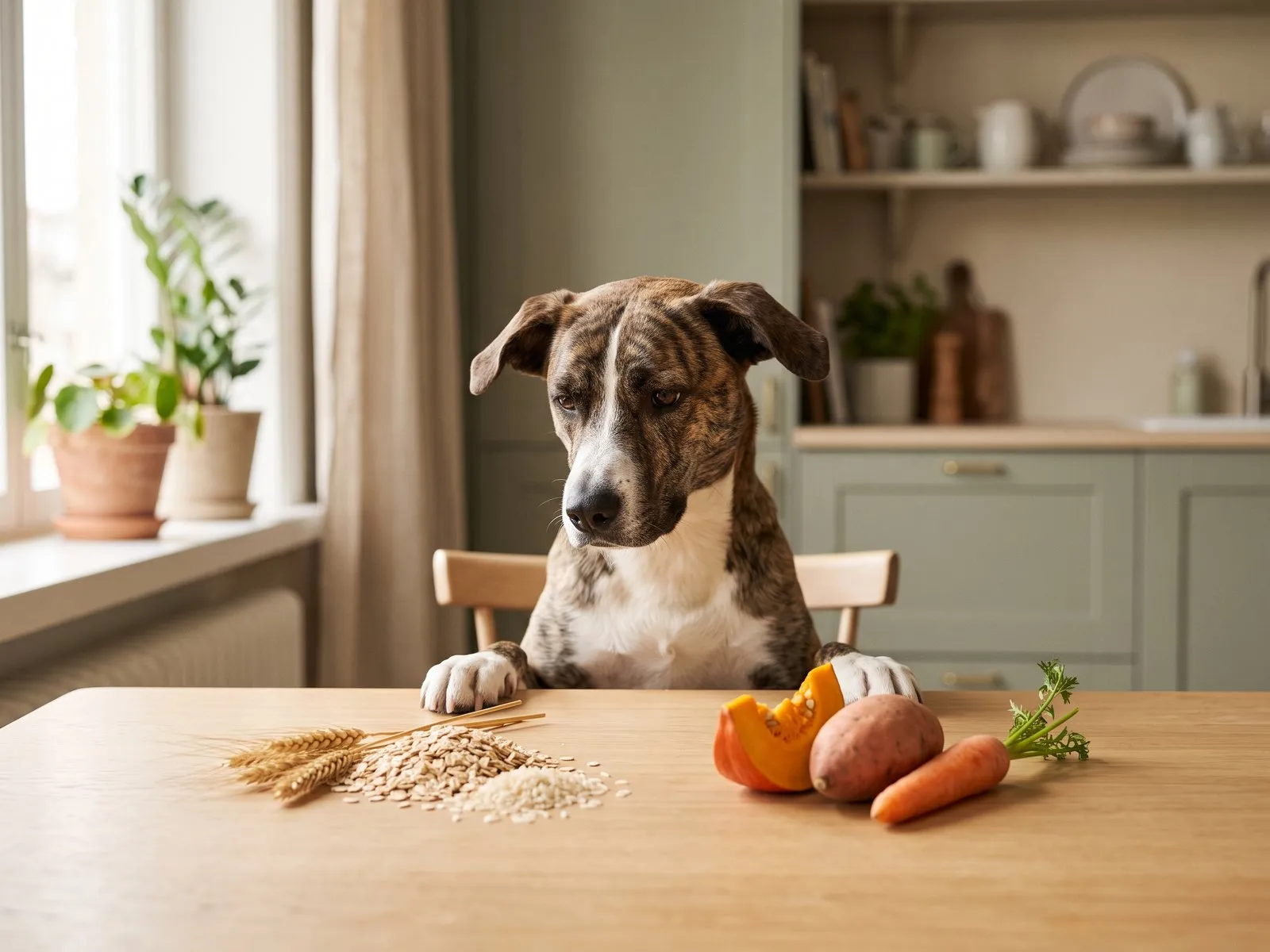
In a good wet food, meat is the base, and fibre and a small amount of carbohydrate can come from vegetables, such as sweet potato or pumpkin, instead of grains or a lot of legumes. This is a useful reference point when comparing grain-free foods: check exactly what has replaced the grain, rather than stopping at the slogan on the front of the can.
Ask about quality, not the slogan on the label
Instead of asking whether a food is grain-free, ask whether it has a good, complete composition suited to your dog’s needs. You can read more about judging the ingredients yourself in our guide to reading dog food labels. It is the quality of the whole recipe, not a single marketing slogan, that decides whether a food is really healthy.
How Veli builds a grain-free recipe
Veli recipes are 100% grain-free, with no potatoes and no legumes. Each one is based on a named meat or fish, making up 40% to 56% of the recipe, and EntoPro™, our proprietary bio-protein. Instead of grains, we add a small amount of vegetables or fruit, such as pumpkin, sweet potato, carrot or banana, which provide fibre. They are complemented by MOS/FOS prebiotics and the TruPet™ postbiotic, which support the gut. We explain exactly what they do on our How it works page.
If you would like to see how such a recipe works for your dog, build your bundle to suit their needs.
Are grains in dog food harmful?
For most healthy dogs, no. Good quality grains are a digestible source of energy. A problem really only arises in dogs with a confirmed allergy or intolerance to a particular grain.
Can a dog be allergic to grains?
Yes, but it happens less often than an allergy to meat proteins. Such an allergy is confirmed with an elimination diet, not on the basis of guesswork or one worrying day.
Is Veli food grain-free?
Yes, all Veli recipes are grain-free. They also contain no potatoes and no legumes such as peas or lentils. The base is meat and our proprietary bio-protein EntoPro™, and a small amount of vegetables or fruit provides fibre.