A dog food label can look like a list of baffling phrases: meat and animal derivatives, additives, vegetable derivatives. The good news is that you do not need to be a pet nutritionist to tell an ingredient list that actually tells you something from one that tells you very little.
The order of ingredients matters
The ingredients on a dog food label are listed in descending order of weight. This means there is more of the first ingredient in the product than of anything else, and least of the last. That is why the first few items on the list deserve the most attention: they, and not the claims on the front of the label, form the real base of the food.
Also check whether one raw material has been split into several items, for example maize, maize flour and maize gluten. Each of them on its own may land lower than the meat, even though together they make up a larger part of the food.
Named meat versus vague terms
A good food gives a specific meat source together with its percentage, for example “beef 50%”. Vague wording such as “meat and animal derivatives” does not tell you which meat it is or how much of it is actually in the can or pouch. A stated percentage is in practice a sign of a transparent manufacturer and a good first filter when choosing a food. The wording “meat and animal derivatives” is, by the way, perfectly legal. It is a category allowed under EU rules that simply does not give away the details. We use the same principles when assessing foods in our wet dog food ranking.
| What the label says | What it tells you |
|---|---|
| beef 50% | the type of meat and its share |
| meat and animal derivatives | neither the species nor the amount |
| vegetable derivatives | neither the raw material nor the amount |
What to watch out for in the ingredients
- Sugar and syrups, added mainly to improve the taste and completely unnecessary in a dog’s diet.
- Colourings and artificial flavour enhancers, which have no nutritional value and are only there to make the food look or taste more appealing.
- Unnecessary fillers and vague derivatives with no clearly stated source, which in practice lower the real nutritional value of the food.
Analytical constituents: the numbers under the ingredients
Below the list of ingredients you will find a small table of analytical constituents: protein, fat, fibre, ash and moisture. When comparing wet food with dry food, remember the moisture. Wet food is about 75 to 80% water, so 10% protein in a can works out, on a dry matter basis, at roughly the same as 40 to 50% in a dry food. The numbers on the label without this conversion can easily mislead.
What else to look for besides meat
Besides the meat itself, functional ingredients also add value to a food: prebiotics and postbiotics that support the gut, and omega-3 fatty acids that benefit skin and coat condition. It is also worth checking whether the food is complete, meaning it can be a full meal on its own, with no need to add anything else to the diet.
An example of a clear ingredient list
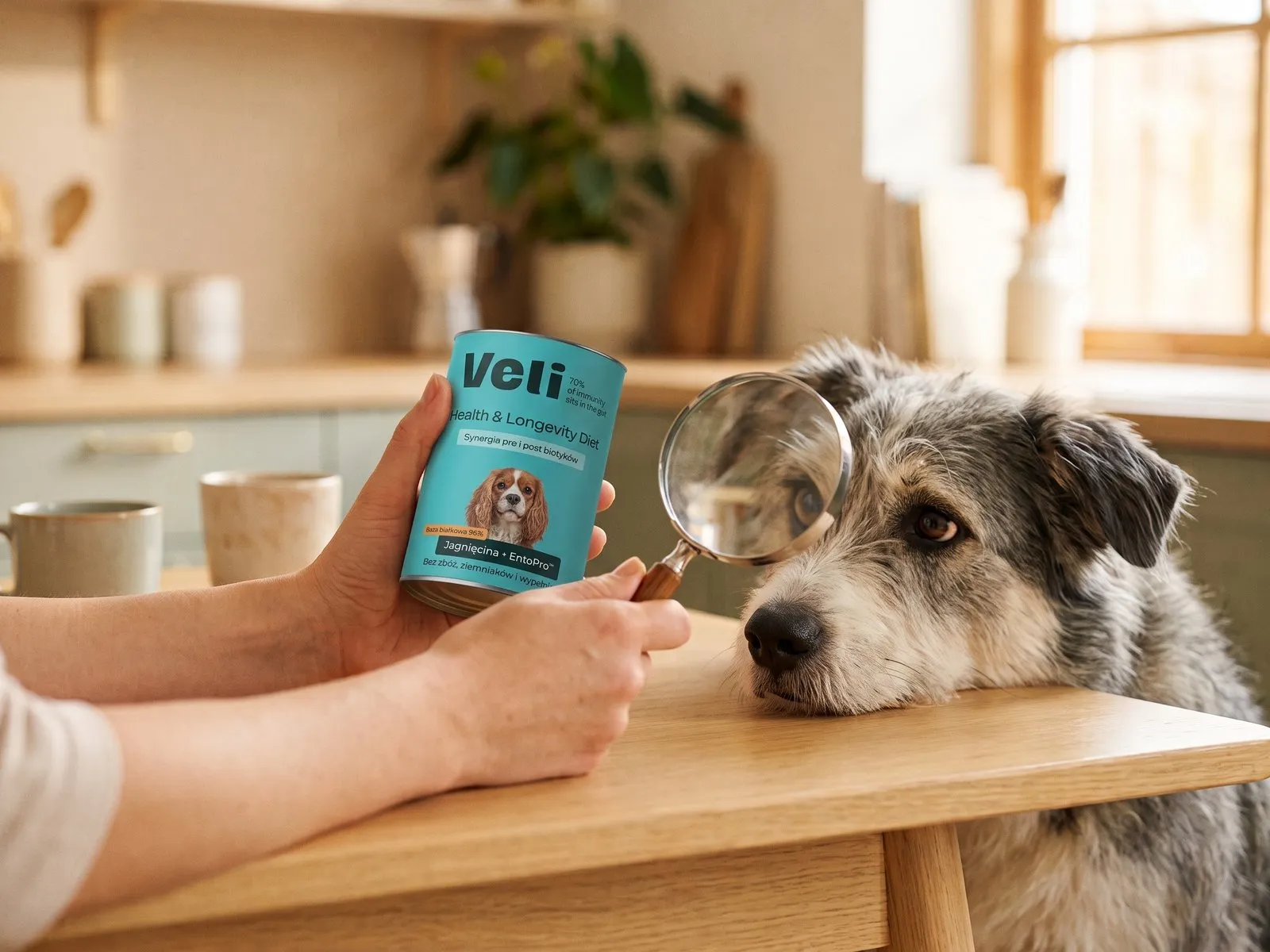
At Veli we believe in radical transparency, so we give a percentage for every ingredient. This is the full composition of the Lamb + EntoPro™ recipe:
| Ingredient | Share | Role |
|---|---|---|
| lamb (including 50.26% lamb meat, 6% offal) | 56.26% | main source of protein |
| EntoPro™, our proprietary bio-protein | 30% | protein and a natural prebiotic |
| lamb broth | 10% | hydration and palatability |
| banana | 2% | fibre and potassium |
| brewer’s yeast | 0.6% | B vitamins |
| salmon oil | 0.6% | omega-3 fatty acids |
| MOS/FOS | 0.4% | prebiotics |
| TruPet™ | 0.14% | a postbiotic that supports the gut |
Every ingredient here has a specific role that can be explained, and you know exactly what goes into your dog’s bowl. If you would like to see it for yourself, build your bundle to suit your dog’s needs.
What should come first in the list of ingredients?
Ideally a named meat with its percentage given. There is more of the first ingredient in the food than of anything else, so it should be a valuable part of your dog's whole diet.
What are animal derivatives?
It is a general term that does not say exactly which ingredients they are or which animal they come from. The more vague terms like this in the ingredient list, the less you really know about the food.
What percentage of meat should a good food contain?
There is no single number that applies to every food, but in a good wet food the named meat sits at the start of the ingredient list and makes up a significant part of it. Above all, the percentage should be given on the label at all.