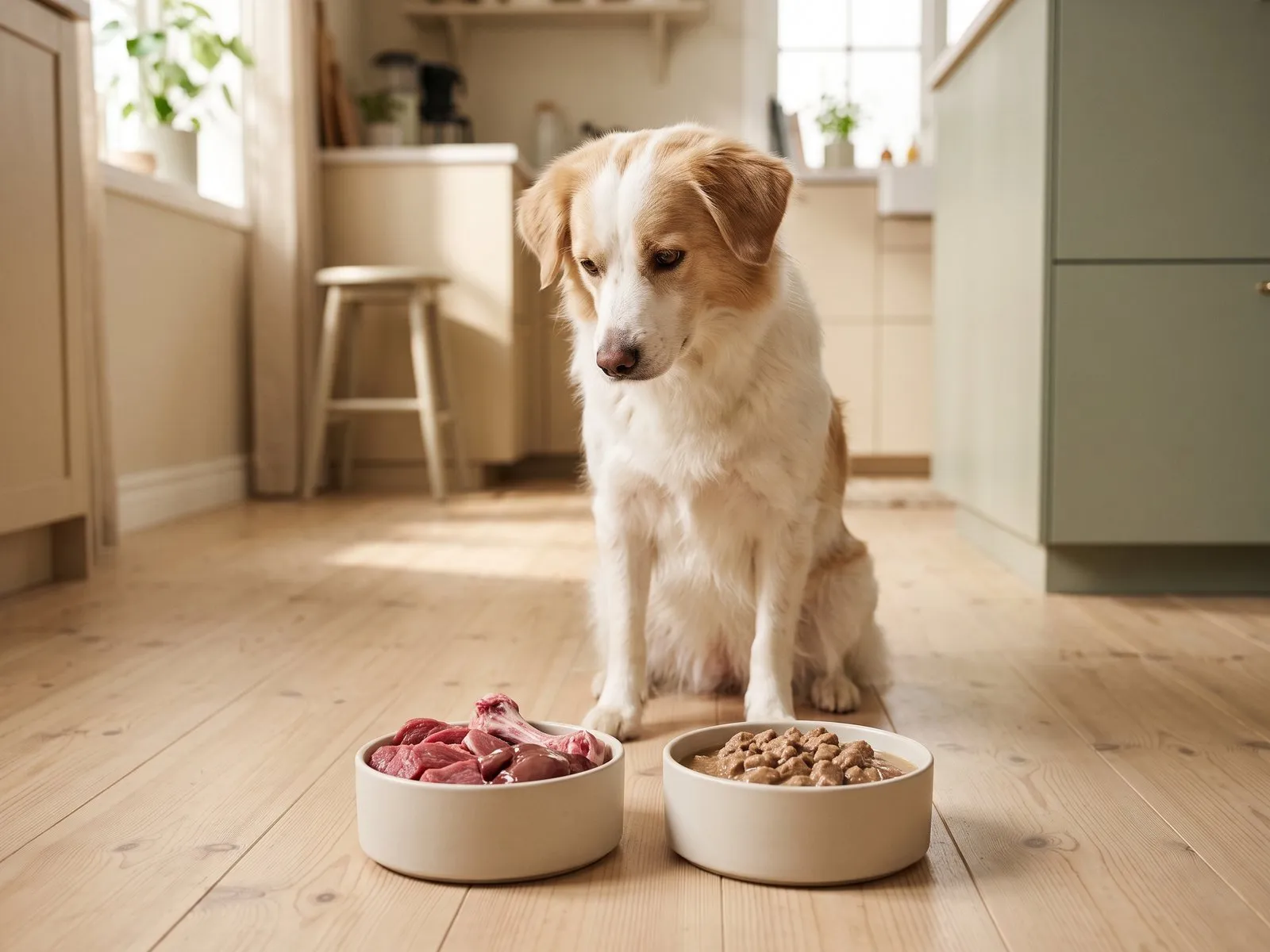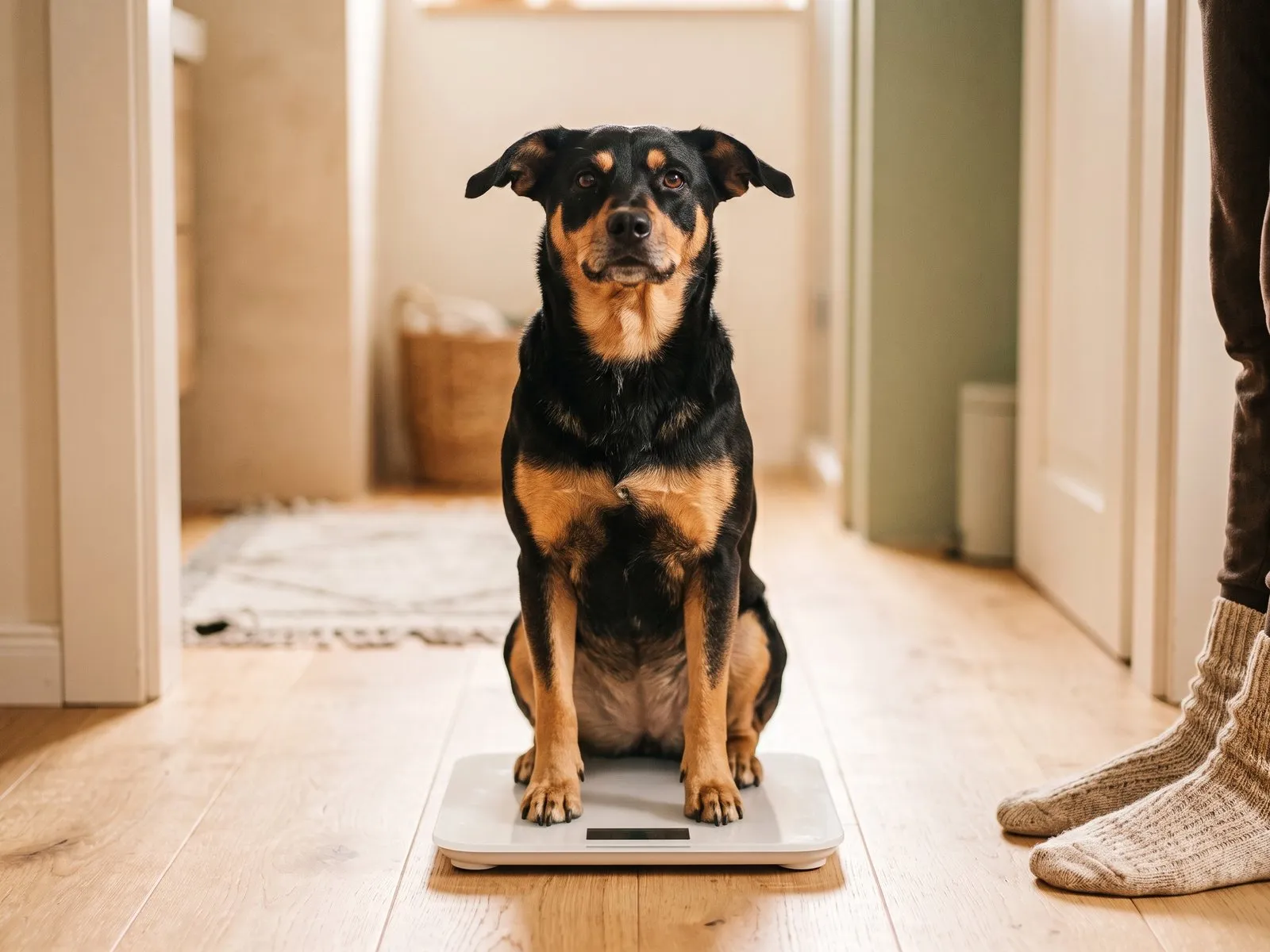
A few extra kilos on a dog are easy to brush off, especially when they crept on slowly, month by month. The good news is that you can spot the first signs of excess weight yourself in a few minutes, and weight loss, done calmly, is one of the simpler things you can do for your dog’s health and comfort.
How to check if your dog is overweight
You do not need to put your dog on the scales straight away. A simple test you can do at home in a few minutes is enough.
- Ribs. You should be able to feel them under the skin without pressing hard, but they should not be visible to the naked eye in a dog with a coat typical for the breed.
- Waist from above. Behind the ribs, your dog’s outline should clearly narrow into a visible waist, rather than continuing in one even, rectangular shape.
- Belly in profile. The belly line should rise gently towards the back, towards the hind legs, rather than hanging parallel to the ground.
If you cannot feel the ribs even with light pressure and the waist has practically disappeared, your dog is most likely overweight.
How excess weight affects your dog
Extra kilos put strain on your dog’s joints and heart, raise the risk of diabetes and lower their overall fitness and willingness to move. The good news is that excess weight can be calmly reversed, and even a small change for the better usually improves your dog’s wellbeing and energy fairly quickly. This is not a reason to feel guilty, just a signal for a small adjustment to the diet. In an older dog, weight needs watching in both directions, which we cover in our guide to feeding a senior dog.
How to help your dog lose weight step by step
- Set a target weight with your vet. They will assess your dog’s build and condition and, at the same time, rule out illnesses that can encourage weight gain, such as an underactive thyroid.
- Adjust the daily portion. Reduce the amount of the current food or choose a lower-calorie recipe, matched to the target weight, not the current one.
- Cut down on treats and count them in the daily calorie allowance, rather than treating them as an extra that does not matter. As a rule of thumb, they should not exceed about 10% of daily energy. Some rewards can also come from the daily portion of food.
- Increase activity by gradually lengthening walks and adding more movement and play during the day.
- Weigh your dog regularly and adjust the portion as you see progress, rather than sticking to one fixed amount for many months.
The number of meals does not have to change. We explain how to split the daily portion into meals in our guide on how often to feed a dog.
The role of wet food in weight loss
Wet food has a high water content, so for the same number of calories it gives more volume in the bowl than dry food. The bowl does not look like a “diet” bowl, and many dogs find a fuller meal easier to accept. This makes it easier to stick to the diet, for you too, because it is harder to give in to a pleading look over an empty bowl.
What not to do when your dog is losing weight
Do not starve your dog and do not cut portions drastically from one day to the next. Losing weight too fast is dangerous to health and usually ends in a yo-yo effect, with your dog quickly regaining the lost weight, and often more. A calm but steady pace of change is far better.
How Veli sets the portion for weight loss
Of the six Veli recipes, Venison + EntoPro™ has the fewest calories: 94 kcal per 100 g, compared with 123 kcal in the other recipes. Venison is also a lean meat, so it is a good starting point for a dog who needs to lose weight.
We calculate the daily portion from your dog’s weight, age and lifestyle. When you build your bundle, we will also ask about your dog’s body shape. If you tick that they tend to put on weight, we will reduce the portion accordingly. Even so, the weight-loss plan and target weight are best agreed with your vet, and the portion adjusted as your dog makes progress.
How quickly can a dog lose weight?
A safe pace is a loss of about 1 to 2 percent of body weight a week. Slower weight loss lasts longer and is safer than a drastic, restrictive diet.
How much should a dog eat on a weight-loss diet?
Enough to move gradually towards the target weight with a slight calorie deficit. The portion is best calculated from that target weight, not the current one.
Does wet food help a dog lose weight?
It can help, because its high water content gives more volume in the bowl for the same number of calories. Matching the portion size to your particular dog's needs still remains the key.